Start with the journey you need to explain
You recognise the word guagua. Good. Now you need to know whether it goes where you are going, where to wait and where to get off. Cuban transport vocabulary becomes useful when you can put the vehicle and the destination into the same question. Start with ¿Esta guagua va al centro?: “Does this bus go to the centre?” The destination gives the question a clear purpose.
The exchanges below are original written practice examples. Use them to build a question, check an answer and ask for the missing detail. Keep a place name you actually need in the destination slot. For a broader introduction before a trip, read our Cuban Spanish guide for travellers; here we will work closely with four transport words.
Guagua: recognise the bus, then ask about its route
The ASALE entry for guagua records the bus meaning in Cuba. Learn the article with the noun: la guagua. Then add the information you need: ¿Dónde se coge la guagua para el centro? asks where to catch it. ¿Esta guagua pasa por el mercado? asks whether its route passes the market. Those questions require different answers.
Listen for the place and the next action in the reply. En la otra esquina directs you to another corner; it does not confirm the route of the bus in front of you. Follow up with ¿La que para allí? to check which one the speaker means. Our guide to question word order helps you recognise other arrangements you may hear.
Máquina tells you about a car
ASALE includes a Cuban sense of máquina meaning a car. English “machine” will not help much in that conversation. In Vamos en la máquina de mi hermano, the rest of the sentence identifies whose car it is. Read the full phrase before deciding what kind of journey is being discussed.
A car word alone leaves practical questions open. Ask ¿Es compartido o privado? if you need to clarify the service being offered. Ask about the destination as well. Keep máquina in your vocabulary alongside automóvil and carro, while learning the particular use from the exchange. For repeated vocabulary practice, the Cuban transport activity has its own academy access.
Almendrón describes a particular kind of vehicle
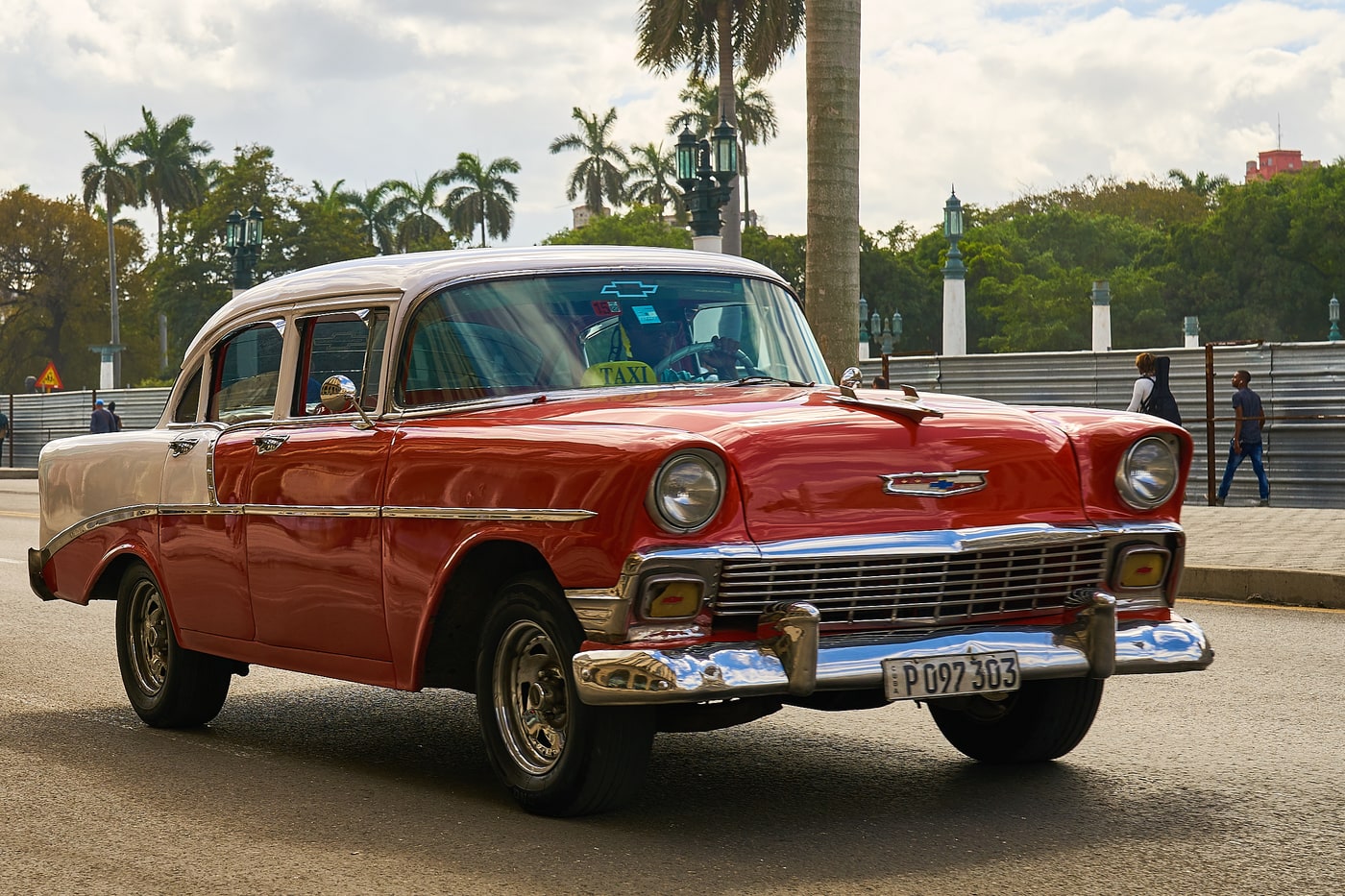
An almendrón is a more specific word than a general car label. The ASALE definition describes an old US-made automobile associated with Cuba. A photograph may help you recognise the kind of vehicle. It cannot tell you what service a particular driver offers, what route is being followed or what a journey costs.
Separate recognition from confirmation. ¿Ese almendrón va para la plaza? asks about the destination. ¿Dónde nos deja? asks where you will be dropped off. Learn those questions together: knowing the name of a vehicle is useful, and checking the endpoint makes the conversation much clearer.
Botella: follow the ride meaning in context
A bottle on a table and a transport conversation give botella very different contexts. ASALE records a Cuban ride sense: a free lift in a vehicle already travelling in the same direction. In transport vocabulary, learn the expression coger botella as a unit, rather than translating each word separately.
The destination still matters. Practise ¿Vas para el centro? followed by ¿Hasta dónde llegas?. The second question checks how far the person is going; it is more precise than assuming both journeys have the same endpoint. Listen for an endpoint in the answer, then repeat that place name to check you understood it.
Check what a price covers
A useful fare question includes the destination: ¿Cuánto cuesta el viaje hasta la plaza?. Once you receive a price, ask what it covers. ¿Ese precio es por persona o por el viaje completo? separates two very different interpretations. You can practise the question without memorising a fare that may have nothing to do with your journey.
Confirm the agreement in one short sentence: Entonces, ese es el precio hasta la plaza, ¿verdad?. If the reply is unclear, ask again before treating it as settled. Our guide to polite requests provides ways to ask for an action or clarification while keeping the request easy to understand.
Ask where to get off and check the answer
¿En qué parada me bajo? asks which stop you need. ¿Me avisa cuando lleguemos? asks the other person to let you know when you arrive. Keep the two purposes separate: a place answer and an agreement to help you are different kinds of information. You can also ask someone to repeat a stop name.
Try a short written exchange: ¿Esta guagua va a la plaza? — Sí. — ¿En qué parada me bajo? — En la próxima. After hearing próxima, you need to connect the word with the next stop. If you missed the reply, use ¿Puede repetir el nombre de la parada?. The clarification guide gives you more ways to keep the exchange going.
Build a small vocabulary you can use
Give each entry a word, a situation and a question. Guagua can lead to a route question; máquina to a question about the car or journey; almendrón to identifying the vehicle; botella to understanding a lift in the same direction. Read your question aloud, change the destination and check that the answer you expect still fits it.
Continue with the Cuban food and menu vocabulary guide: arriving somewhere and asking what is available are two useful everyday tasks. For personal feedback, bring a destination question and an unclear reply to an online Cuban Spanish class. A small exchange you understand is a strong starting point for the next conversation.